When I think back to watching WWF as a kid, there are certain voices that instantly take me back. Gorilla Monsoon booming from the commentary desk. Gene Okerlund conducting interviews backstage. Vince McMahon getting a little too excited whenever Hulk Hogan started making his comeback.
But there was one voice that always made me smile before a match had even started: Bobby “The Brain” Heenan.
Prime Time Wrestling wasn’t just another wrestling show. It felt different. It was part recap show, part comedy, part talk show, and part wrestling, all rolled into one. Sure, there were plenty of classic matches from arenas around the country, but if I’m being honest, I often looked forward to the segments between the matches just as much.
And that’s because Bobby Heenan had a way of turning even the simplest conversation into comedy.
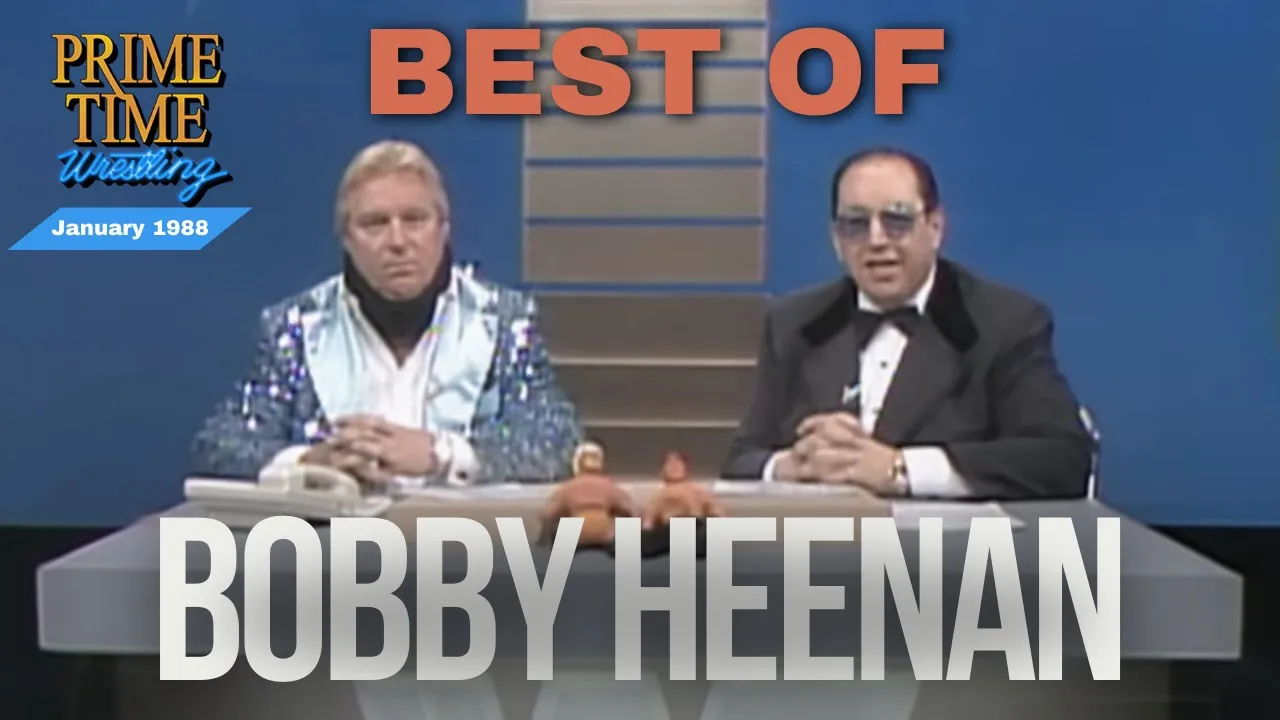
When Heenan became Gorilla Monsoon’s regular co-host, Prime Time Wrestling found its identity. The chemistry between the two wasn’t something you could manufacture. It felt like two people who genuinely enjoyed getting under each other’s skin every Monday night.
Of course, Gorilla usually played the straight man. Calm. Reasonable. Patient.
Heenan?
He was anything but.
Every week, he would stroll onto the set with some ridiculous excuse, a new scheme, or an outrageous opinion that somehow made perfect sense in his own mind. Whether he was defending one of his wrestlers after an obvious act of cheating or insisting that Gorilla was biased against the entire Heenan Family, he never seemed to run out of material.
The funny thing is, I don’t remember thinking about any of this as a kid. I just knew it was entertaining.
Watching those episodes today, though, I appreciate just how difficult that role must have been. Bobby Heenan wasn’t simply reading lines. He was constantly improvising, reacting, interrupting, and throwing in little one-liners that made every conversation feel alive.
Half the time, it looked like Gorilla was trying not to laugh.
That was part of the magic.
One thing that always stood out to me was how effortless Heenan made everything seem. Some wrestling managers could deliver a great promo when they had a microphone and a few uninterrupted minutes. Heenan could create comedy out of absolutely nothing.
Someone could mention a wrestler, and within seconds Heenan would have a sarcastic remark ready.
A match graphic appeared?
He’d complain about it.
A replay was shown?
He’d explain why the referee had made the wrong call.
A fan sign appeared on screen?
He’d probably insult the fan.
Nothing was ever off limits.
It also helped that Prime Time Wrestling wasn’t restricted by the fast pace of today’s television. The hosts had room to breathe. Conversations wandered off topic. Running jokes lasted for weeks. Some episodes almost felt like you were sitting in the living room with Gorilla and Bobby while wrestling just happened to be playing on the television.
I don’t know if younger fans who discover Prime Time Wrestling today always appreciate that slower pace. If you’re expecting nonstop matches, you might wonder why the hosts spend so much time talking.
But that’s exactly why so many of us remember the show so fondly.
The conversations were the show.
The wrestling simply gave Gorilla and Bobby something new to argue about.
One of my favorite things about Heenan was that he never broke character.
Ever.
It didn’t matter if one of his wrestlers lost cleanly in the middle of the ring. Bobby would immediately have an explanation.
The referee missed something.
The opponent cheated.
Someone was distracted.
The lighting wasn’t right.
Anything except admitting his guy had been beaten fair and square.
Looking back now, that’s what made him such a believable manager. He defended his wrestlers the same way a sports fan defends their favorite team after a bad loss. The logic didn’t always hold up, but the confidence certainly did.
You almost wanted to believe him.
Almost.
Prime Time also gave viewers something they didn’t always get on Superstars or Wrestling Challenge: time to let personalities shine.
Instead of rushing from match to match, Bobby could tell stories. He could complain about Gorilla. He could tease upcoming matches. He could react to interviews. He could spend several minutes building anticipation for something that might only last a few seconds once it actually aired.
Somehow, that never felt like filler.
It felt like spending time with familiar friends.
The famous set helped, too. Rather than sitting behind a traditional announcer’s desk, Gorilla and Bobby often looked like they were relaxing in someone’s living room. There were couches, chairs, decorations, and all sorts of little props that Heenan inevitably found a way to misuse.
How many arguments started because Bobby touched something that clearly wasn’t his?
Or because he helped himself to food that Gorilla had sitting nearby?
Those little moments had nothing to do with wrestling, yet they’re some of the scenes I remember most vividly.
Then there were the holiday episodes.
Prime Time Wrestling always seemed to have fun whenever Christmas rolled around, and Bobby usually found some way to make things wonderfully chaotic. Whether he was arguing over decorations, trying to avoid doing any actual work, or finding a way to turn Christmas into another excuse to praise the Heenan Family, he always seemed completely committed to the bit.
It made the show feel special.
You weren’t just watching another wrestling program.
You were spending the holidays with Gorilla and Bobby.
Another thing I’ve grown to appreciate is just how quick Bobby Heenan really was.
Not rehearsed.
Quick.
There are countless moments where Gorilla says something completely ordinary, and within a second Bobby has a comeback ready that feels completely natural.
That’s a rare talent.
Even today, when you watch old clips, many of those jokes still land because they’re based on timing rather than references that have become dated.
It’s no surprise that so many wrestlers have said Heenan was one of the funniest people they’d ever met.
Prime Time Wrestling gave him the perfect stage to prove it every single week.
Of course, Bobby could also switch gears instantly.
If one of his wrestlers appeared in a serious interview, suddenly the jokes stopped.
Now he was the protective manager.
The salesman.
The strategist.
He could convince you that his wrestler was unbeatable while still making you laugh ten minutes earlier over something completely unrelated.
Not many performers could balance comedy and credibility like that.
Maybe that’s why Bobby Heenan has aged so well.
A lot of wrestling comedy from the 1980s feels very much of its time.
Heenan’s comedy usually came from his personality.
He wasn’t relying on catchphrases.
He wasn’t relying on slapstick every week.
He simply looked at every situation from Bobby Heenan’s completely self-serving point of view.
That character never changed.
Watching Prime Time today, I also notice how much trust WWF had in him. Entire segments revolved around Bobby talking. Sometimes it wasn’t even about promoting a match. It was simply giving Bobby and Gorilla time to entertain the audience.
That’s a remarkable amount of confidence to place in someone.
And they were right.
Because even decades later, fans still share clips of those conversations online.
People quote Bobby’s one-liners.
People remember Gorilla’s exasperated reactions.
People still debate which episodes were the funniest.
Very few studio wrestling shows have left that kind of lasting impression.
When people remember Bobby Heenan, they’ll naturally think about his legendary managing career, his unforgettable commentary alongside Gorilla Monsoon, or his time in both WWF and WCW. All of those deserve the praise they receive.
But for me, Prime Time Wrestling will always be one of the best showcases of what made Bobby Heenan special.
It wasn’t just that he was funny.
It was that he made every Monday night feel like anything could happen before the opening match even began.
Looking back, I realize I wasn’t simply tuning in to see wrestling.
I was tuning in to spend an hour with Gorilla Monsoon and Bobby Heenan.
The matches were great, but those conversations between two men who played off each other so perfectly are what I remember most.
And honestly, after all these years, that’s still the first thing that comes to mind whenever someone mentions Prime Time Wrestling.